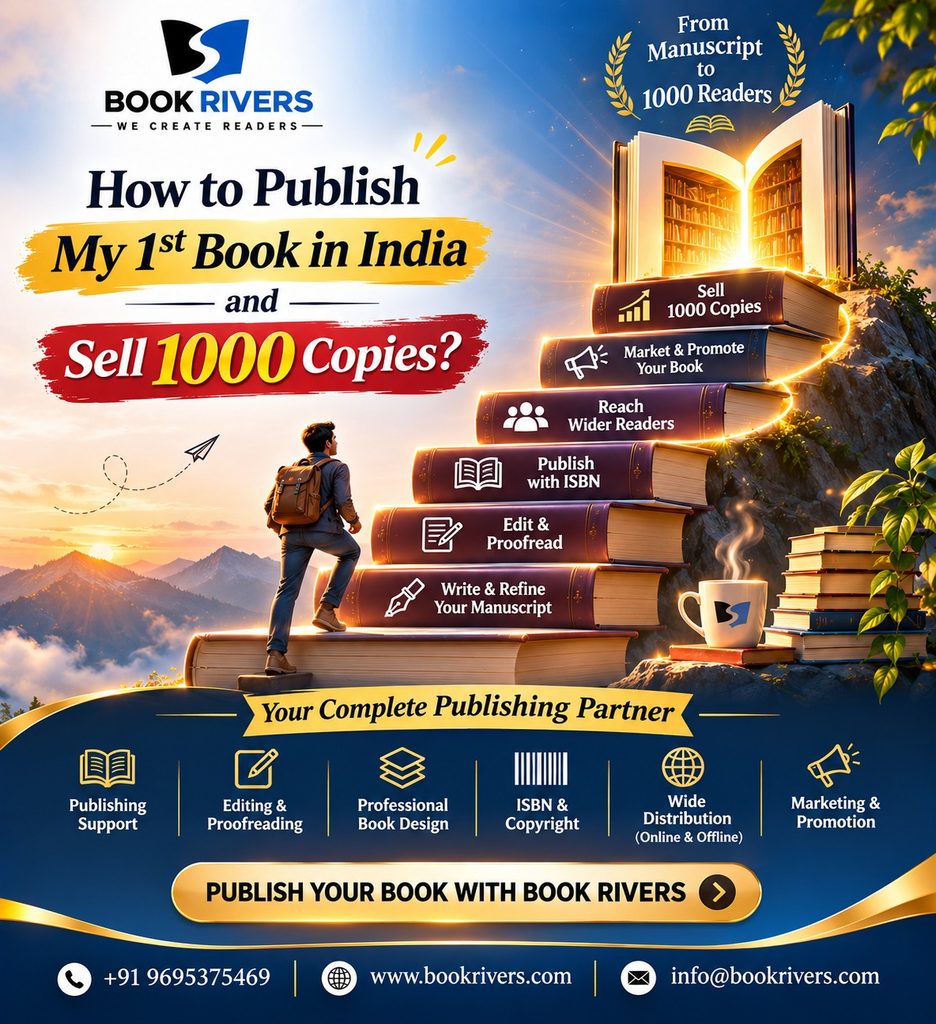
Publishing your first book is an exciting milestone. However, transforming a manuscript into a successful publication requires careful planning, an appropriate publishing strategy, and consistent marketing efforts. Many aspiring authors in India share a common question: How can I publish my first book and work towards selling at least 1,000 copies?
This step-by-step guide explains the essential stages of publishing your first book and developing a practical strategy to reach your sales target.
- Complete and Prepare Your Manuscript
The first step is to prepare a well-structured and thoroughly reviewed manuscript. Whether you are writing fiction, poetry, academic content, self-help, or a professional book, ensure that your content is original, engaging, informative, and relevant to your intended audience.
Before proceeding with publication, consider the following:
•
Get your manuscript professionally edited and proofread.
•
Organise chapters, headings, references, illustrations, and other supporting material.
•
Create an attractive and professionally designed book cover.
•
Format the interior pages according to standard publishing requirements.
A well-prepared book creates a positive first impression, enhances readability, and encourages readers to recommend it to others. - Choose the Right Publishing Method
Authors in India generally have three primary publishing options:
•
Traditional Publishing: Submit your manuscript to an established publishing house. If accepted, the publisher generally manages editing, printing, distribution, and marketing according to the terms of the publishing agreement.
•
Self-Publishing: Publish your book independently while retaining greater control over the content, pricing, publication decisions, and royalties.
2
•
Assisted Publishing: Collaborate with a professional publishing company that provides services such as manuscript editing, cover design, ISBN assistance, typesetting, printing, and distribution.
Select a publishing model based on your budget, expectations, publication goals, and preferred level of involvement in the process. - Obtain an ISBN and Publish Your Book
An ISBN (International Standard Book Number) is a unique identifier used to identify a book in the publishing and bookselling industry.
In India, authors and publishers can apply for an ISBN through the official Raja Rammohun Roy National Agency at www.isbn.gov.in. The agency currently provides ISBNs free of charge.
Once the necessary publishing details have been finalised, prepare the copyright page, book description, pricing information, and print-ready files. Authors can also explore platforms such as Amazon Kindle Direct Publishing (KDP) for e-books and eligible print-on-demand services, along with Indian publishing and distribution providers, for physical editions. - Develop a Marketing Strategy Before Launch
Book marketing should begin well before the publication date. Ideally, start building awareness at least 30 days before the planned launch.
Some effective promotional activities include:
•
Share book-cover reveals, author introductions, and interesting excerpts on Instagram, Facebook, and LinkedIn.
•
Create engaging promotional videos, reels, and other visual content.
•
Build a WhatsApp community of potential readers and interested audiences.
•
Send advance copies to book reviewers, bloggers, educators, and relevant influencers.
•
Announce the upcoming publication through email campaigns and social media.
•
Organise online and offline book-launch events.
Consistent promotional activities help generate interest, build anticipation, and encourage early purchases.
3 - Create a Practical Strategy to Sell 1,000 Copies
Selling 1,000 copies requires a well-planned and measurable sales strategy. Rather than depending on a single promotional channel, authors should explore multiple opportunities to reach potential readers.
The following is an illustrative distribution of a 1,000-copy sales target:
•
200 copies: Personal networks, professional contacts, and launch campaigns.
•
200 copies: Social media promotions and online marketing.
•
200 copies: Educational institutions, libraries, and organisations.
•
200 copies: Bookstores, book fairs, exhibitions, and author events.
•
200 copies: Online marketplaces and reader referrals.
These figures represent planning targets rather than guaranteed sales. Monitor actual purchases, exclude free promotional copies from sales figures, and regularly review the performance of each channel. Adjust your promotional strategy according to reader response and sales results. - Build and Maintain Your Author Brand
An author’s publishing journey does not end with the book launch. Building a recognisable author profile requires continuous engagement with readers and the literary community.
To strengthen your author brand:
•
Share informative and engaging content related to your book and area of expertise.
•
Interact with readers through social media and literary platforms.
•
Encourage genuine reader reviews and feedback.
•
Participate in book fairs, literary festivals, seminars, and other relevant events.
•
Maintain an updated author profile and professional online presence.
•
Keep readers informed about upcoming projects and publications.
A consistent author presence helps establish credibility, develop reader relationships, and create opportunities for future